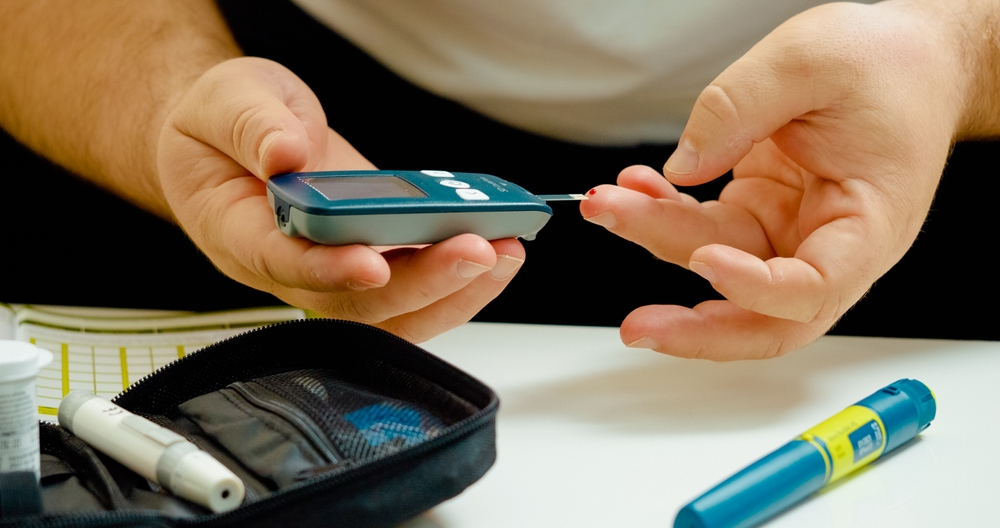
Insulin needles and syringes come in a range of types, gauges, lengths and capacities. Understanding these measurements can make it easier to compare products and identify the option that matches your prescribed insulin delivery device.
One of the most important distinctions is whether you use an insulin pen or insulin supplied in a vial for use with a syringe. These use different products.
This guide explains the main types of insulin needles and syringes, what needle gauge and length mean, and how common insulin syringe sizes differ.
Two of the main products used for insulin administration are pen needles and insulin syringes.
Although both use a needle to deliver insulin into the subcutaneous tissue beneath the skin, they work with different delivery systems.
Pen needles are small, detachable needles designed to fit compatible insulin pens. The pen contains the insulin and is used to set the prescribed dose. The pen needle provides the route through which the insulin is injected.
Pen needles are available in different gauges and lengths, with common lengths including:
Compatibility can vary between products, so check the instructions supplied with your insulin pen and pen needle before use.
For more detail on pen-needle sizes, gauges, compatibility and choosing between different options, see our Quick Guide to Pen Needles for Insulin.
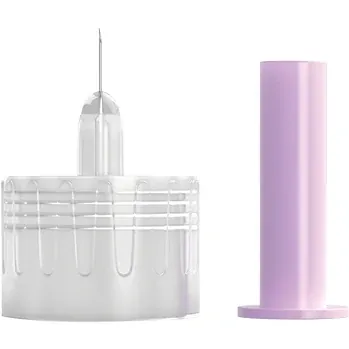
Insulin syringes are generally used to draw up and measure prescribed insulin from an appropriate vial.
They have graduated markings on the barrel and are available in different:
A fixed needle is permanently attached to the syringe barrel, while detachable-needle syringes are designed for use with a separate compatible needle.
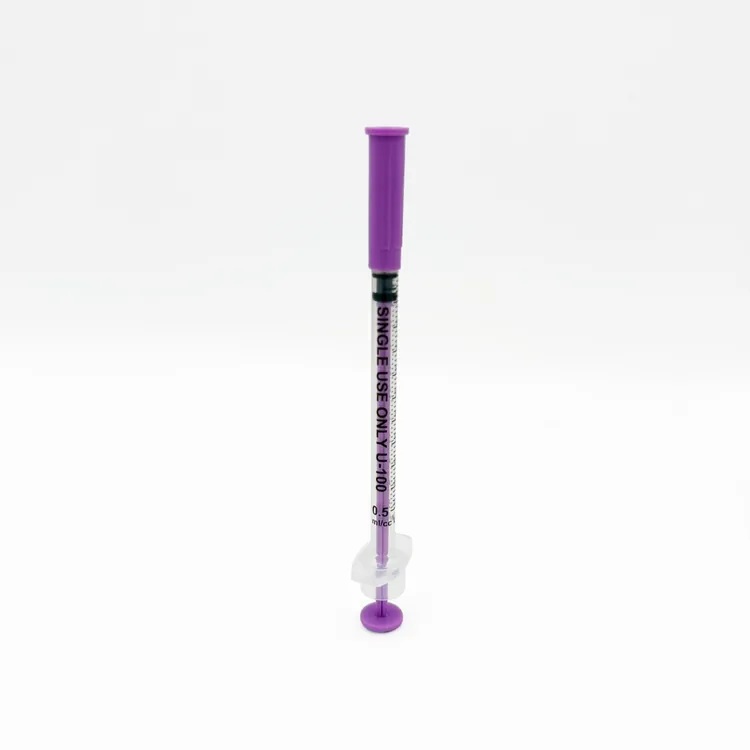
Important insulin safety information: Never use an insulin syringe to withdraw insulin directly from an insulin pen or replacement cartridge. Some insulin pens contain insulin at concentrations above 100 units/mL, which can create a serious risk of dosing error if measured using a U-100 syringe.
Needle gauge, shown as a number followed by G, describes the outside diameter of the needle.
The higher the gauge number, the narrower the needle.
For example:
For insulin delivery, fine-gauge needles are commonly used, with pen needles often found around 31G to 33G. Insulin syringe gauges vary more by product and manufacturer, with options available across a broader range.
A narrower needle may affect how an injection feels, but gauge alone does not determine comfort. Needle-tip design, lubrication, length, injection site and technique can also make a difference.
Gauge should therefore be considered alongside needle length, product design and compatibility, rather than treated as a standalone measure of performance.
Needle length is measured in millimetres (mm) and describes the length of the needle.
Insulin is generally intended to be delivered into the subcutaneous tissue beneath the skin, rather than into muscle.
Pen needles and insulin syringe needles should be considered separately, as the same length guidance does not necessarily apply to both.
Common pen needle lengths include:
Current UK injection guidance commonly recommends short 4 mm pen needles for most people across different body sizes.
A larger body size does not normally mean that a longer pen needle is required. Research has found that skin thickness varies much less than the depth of the fatty tissue underneath, which is one reason shorter pen needles can be suitable across different body sizes.
Children, young people and some very lean people may require different injection technique, so individual advice from their diabetes healthcare professional is important.
Insulin syringe needle lengths need to be considered separately.
The commonly discussed 4 mm recommendation relates primarily to pen needles, rather than insulin syringes.
International injection-technique guidance identifies 6 mm as the shortest recommended insulin-syringe needle length covered by that guidance.
Longer syringe needles, including 8 mm and approximately 12 to 12.7 mm options, are also available.
It is worth noting that longer does not necessarily mean better. Appropriate technique becomes more important as needle length increases.
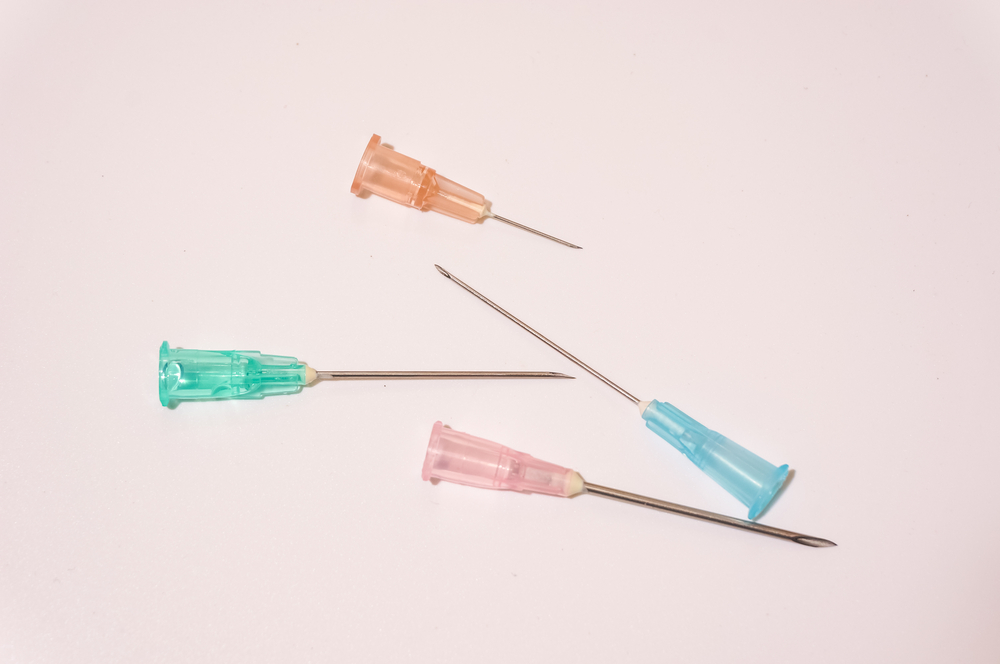
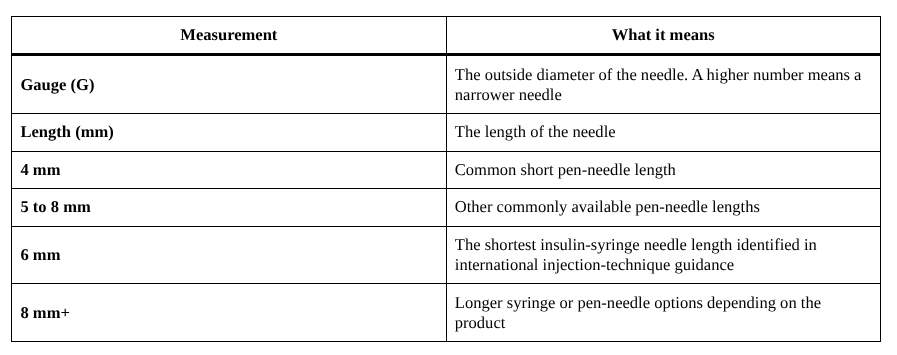
Actual gauges and lengths vary by manufacturer and product.
Insulin syringe size usually refers to the capacity of the syringe barrel.
Common capacities include:
For U-100 insulin, these capacities correspond to:
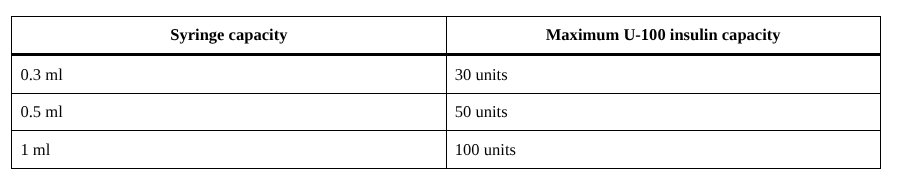
U-100 insulin contains 100 units per millilitre.
Graduation markings can vary between products, so always check the actual scale on the syringe rather than assuming every syringe of the same capacity has identical graduations.
The main points to check are:
Always follow the instructions supplied with your insulin and delivery device, along with advice from your diabetes healthcare professional.
No. A pen needle attaches to a compatible insulin pen, while an insulin syringe is generally used to draw and measure prescribed insulin from an appropriate vial.
Yes. A higher gauge number means a narrower needle, so 32G is narrower than 31G.
Current guidance commonly supports 4 mm pen needles across different body sizes, including for people with obesity.
Having more body fat does not normally mean insulin needs to be injected more deeply.
If you have been advised to use a particular needle length, continue to follow the advice of your diabetes healthcare professional.
U-100 means that the insulin contains 100 units per millilitre. A U-100 insulin syringe is calibrated for this concentration.
The most important starting point is knowing which type of product your insulin delivery system requires.
For an insulin pen, this will usually be a compatible pen needle. If you have been prescribed insulin in a vial for use with a syringe, you will need an appropriate insulin syringe.
From there, gauge, length and syringe capacity can help you compare the available options.
Browse our range of insulin needles and syringes to compare available types, gauges, lengths and capacities.
Sources:
https://www.kmedhealth.com/what-is-the-insulin-syringe/
https://www.healthline.com/health/diabetes/insulin-syringes-sizes#takeaway
https://formularymk.nhs.uk/docs/formulary/06/07082020%20Insulin%20Needles%202020%20Final.pdf