Choosing the right Pen Needle can make insulin injections more comfortable and more consistent. In this quick, plain-English guide, we explain what pen needles are, how they work, how length and gauge affect your experience, and which sizes healthcare bodies in the UK commonly recommend. You will also find clear tips on safer use and links to popular pen needles we stock.
Pen needles are small, single-use needles that screw onto insulin pens and other GLP-1 or diabetes injection pens. They create a short pathway through the skin into the fatty layer underneath, so your medicine is delivered into subcutaneous tissue rather than into muscle. Most modern pen needles are designed to be compatible with a wide range of pens because manufacturers follow ISO standards for thread and performance, although you should always check your device’s instructions.
Good to know: All pen needles are single use. Reusing a needle increases the risk of blocked or dulled tips and can contribute to skin complications such as lipohypertrophy.
When you attach a pen needle and press the pen’s button, the medicine is pushed through the needle into the fatty layer under the skin. The aim is consistent subcutaneous delivery. Shorter needles help reduce the chance of accidentally reaching muscle, which can alter insulin absorption and swing blood glucose levels. UK guidance highlights 4 mm as a safe first-line length for most people, used at a 90-degree angle
The two main measurements used to describe a pen needle are:
You may also see the bevel mentioned when comparing pen needles. The bevel is the angled surface created when the needle tip is cut diagonally. This gives the needle a slanted point rather than a flat, straight-cut end. When the needle enters the skin, the bevelled tip creates an opening gradually, which can help the needle pass through the skin smoothly.
Unlike gauge and length, the bevel is a feature of the needle tip rather than a measurement of its size. Pen needles can have different bevel designs, including 3-bevel and 5-bevel tips. The number refers to the number of angled surfaces ground into the needle tip to form the point.
For example, BD's 5-bevel pen needle design has been studied against similar-length 3-bevel pen needles, with participants in the study reporting a more comfortable and less painful injection experience with the 5-bevel design.
Bevel design is therefore another feature worth looking at when comparing pen needles alongside gauge and length.
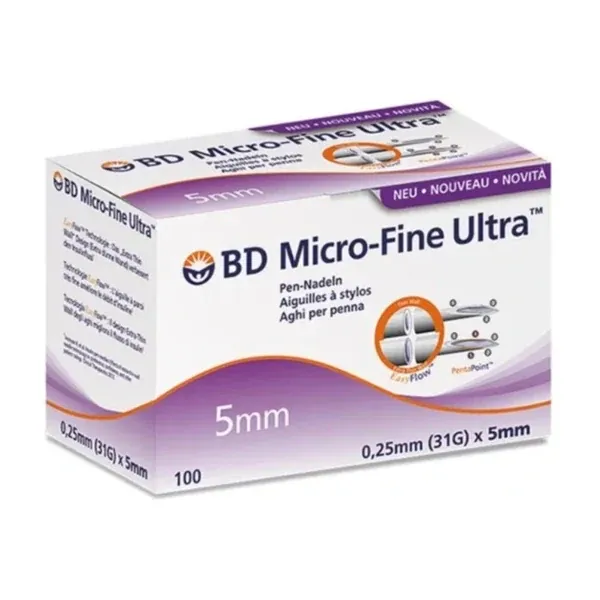
Featuring Pentapoint five-bevel technology, these 32G x 4mm needles are designed to glide smoothly into the skin, helping to reduce pressure and provide a gentler injection experience.

A precise and comfortable solution for insulin delivery, designed to make the injection process easier and less painful.
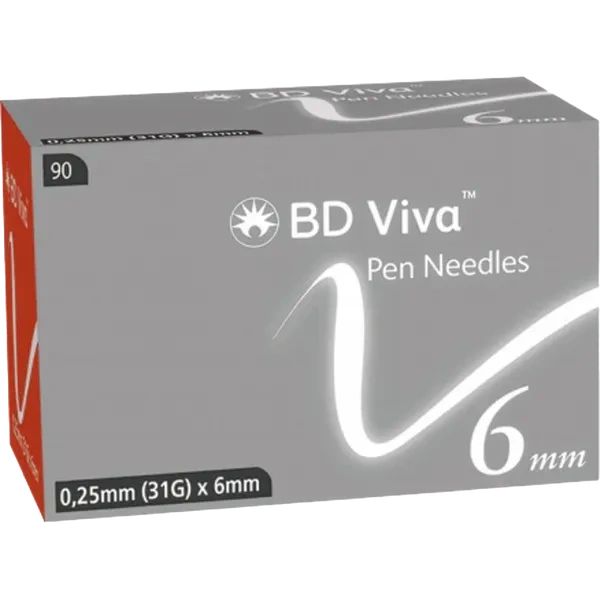
The ultra-fine 31G (0.25mm) needle and short 5mm length help ensure accurate medication delivery with minimal discomfort.

For further information about insulin injection, visit the Diabetes UK website
Choosing the right pen needle helps make injections simpler, safer and more predictable. For most people in the UK, 4 mm is a sensible starting point, with 5–6 mm suitable in some cases under professional guidance. Matching the length and gauge to your needs, rotating sites carefully and using a fresh needle each time can all improve comfort and control.
You can browse our full range of Insulin Needles, Syringes and Pen Needles here.
This guide is for general information only and is not a substitute for medical advice. Always follow the recommendations of your diabetes care team.
Sources:
https://www.diabetes.org.uk/about-diabetes/looking-after-diabetes/treatments/insulin/injecting
https://swlimo.southwestlondon.icb.nhs.uk/wp-content/uploads/Diabetes-Pen-Needles-and-Safety-Needles-Position-Statement-V1.1-1.pdf
https://www.covwarkformulary.nhs.uk/docs/chapter06/RD047-Needles%20for%20Diabetes%20Medicines.pdf
https://hmdhealthcare.com/blog/know-your-pen-needles-length-gauge/
https://primarycare.northeastlondon.icb.nhs.uk/wp-content/uploads/2023/08/Pen-needles-guidance-NEL-v1_07.2023.pdf
https://www.kdlnc.com/insulin-pen-needles-guide/