Keeping first aid supplies up to date can feel simple until the standards change, the kit contents run low, or you need to check whether your workplace provision still matches your risk assessment.
For employers, catering businesses, kitchens, care settings, offices and other workplaces, first aid is not something to guess. You need suitable supplies, clear responsibility and a practical way to keep everything stocked.
The legal information in this guide is based primarily on HSE guidance for workplaces in England, Scotland and Wales. Employers in Northern Ireland should refer to HSENI guidance and the applicable Northern Ireland regulations.
This guide explains what BSI standards for workplace first aid kits cover, how they relate to HSE guidance, what changed with the latest BS 8599-1 update, and how to choose the right kit or refill for your workplace.
The key British Standard for workplace first aid kits is BS 8599-1. It gives a specification for the contents of workplace first aid kits and, in the latest version, also covers guidance around the provision and placement of automated external defibrillators, known as AEDs.
The current standard listed by BSI is BS 8599-1:2019+A1:2026, published on 30 April 2026.
In simple terms, BSI workplace first aid kits are designed to give employers a clear benchmark when choosing first aid supplies. Workplace kits are commonly supplied in small, medium and large formats. The standard’s recommendations take account of both workplace risk category and the number of people on site.
A BSI kit can help with:
At SHD Medical, our first aid kits range includes practical options for workplace, care, catering and general use, including first aid kits designed to meet recognised BS 8599 workplace kit specifications.
This is an important point. A BSI first aid kit is not automatically a legal requirement in itself.
Under the Health and Safety (First-Aid) Regulations 1981, employers must provide adequate and appropriate first aid equipment, facilities and personnel so employees receive immediate attention if they are injured or taken ill at work.
HSE guidance also says the contents of your first aid kit should be based on your first aid needs assessment. If you are buying a kit, HSE advises looking for British Standard BS 8599, but also makes clear that the law does not require your kit to meet that standard.
That means the key question is not simply, “Do we have a BSI kit?”
A better question is:
Does our first aid provision reflect the risks, layout, number of people on site and working patterns of our workplace?
For many employers, choosing a BSI compliant first aid kit is a straightforward way to start from a recognised specification. You should still review whether you need extra items based on your own workplace risks.
For example, a small office may have very different needs from:
BS 8599-1:2019+A1:2026 was published on 30 April 2026. The current title and scope now cover workplace first aid kit contents and containers, together with requirements concerning the provision and placement of automated external defibrillators, or AEDs, in workplace environments.
The amendment does not create a general legal requirement for every workplace to have an AED. Employers must continue to base their first aid arrangements on the circumstances of their workplace and the findings of their first aid needs assessment.
The full standard should be consulted before making a formal claim that a kit, workplace arrangement or AED provision conforms to BS 8599-1:2019+A1:2026.
Separately, HSE advises employers to keep first aid kits accessible, check their contents regularly and restock them soon after use. Expired items should be replaced, and any additional equipment should reflect the hazards and risks identified in the workplace.
Employers should consider:
If your existing case is still in good condition, a refill can be a cost-effective way to restock. SHD Medical stocks options such as the BSI compliant medium first aid kit refill and the BSI compliant small first aid kit refill for workplaces that need to replace contents without buying a new case.
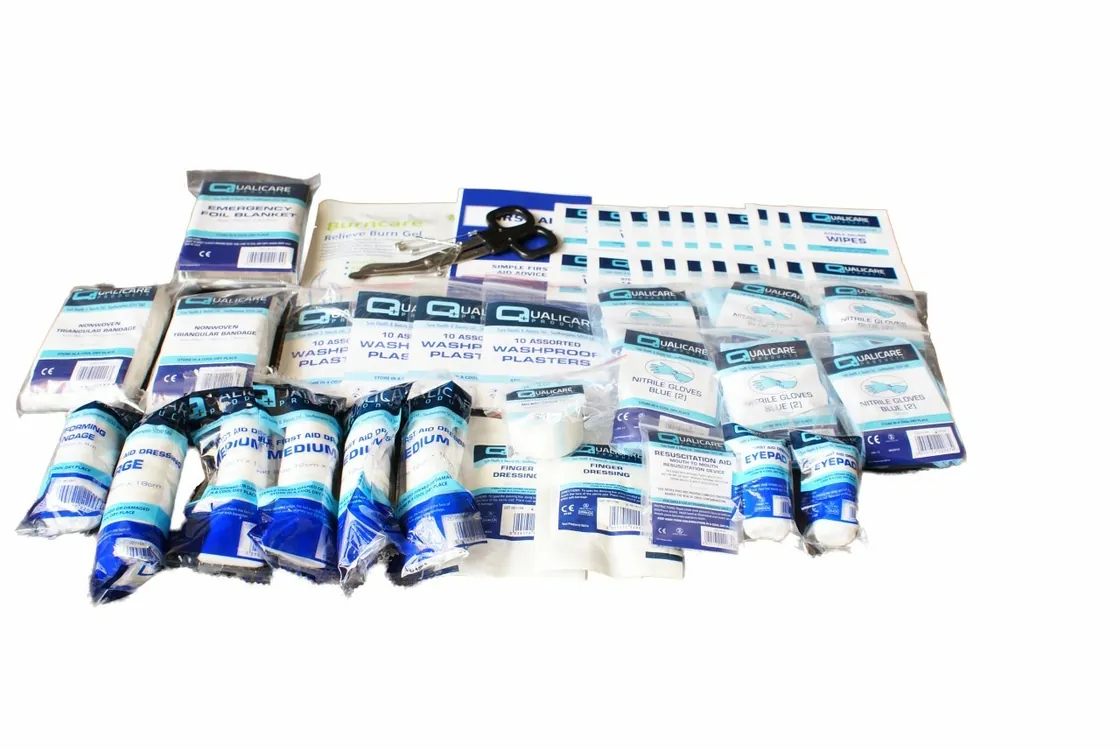
BSI first aid kits are commonly selected by size, with small, medium and large formats.
A larger workplace may need more than one kit, especially if staff are spread across different floors, kitchens, warehouses, vehicles or outdoor areas.
A large workplace first aid kit such as the BSI compliant large first aid kit in box, 50 person kit, may form part of the provision for a higher-headcount site, but suitability should be checked against both the workplace risk category and the number of people on site.
Smaller sites, lower-risk environments or locations that already have a suitable case may prefer refill kits to keep supplies complete and current.
When reviewing your first aid provision, think about:
Catering environments have their own practical challenges. Staff may be working with heat, knives, glass, hot liquids, cleaning products, slippery floors and fast-paced service pressures.
For catering businesses, first aid provision should reflect the actual working environment. Depending on the findings of the first aid needs assessment, a catering-format workplace kit may be appropriate. Additional equipment may still be needed for hazards such as burns or chemical exposure.
A catering first aid kit often uses blue plasters, which are commonly chosen in food preparation environments because they can be more easily visually identified. Some catering plasters are also metal detectable, depending on the product specification. This can help food businesses keep first aid supplies aligned with practical kitchen and food handling expectations.
For food service teams, commercial kitchens, cafés, catering vans and hospitality sites, SHD Medical stocks the BSI first aid kit medium catering as a consideration for workplace catering environments.
Caterers should also check:
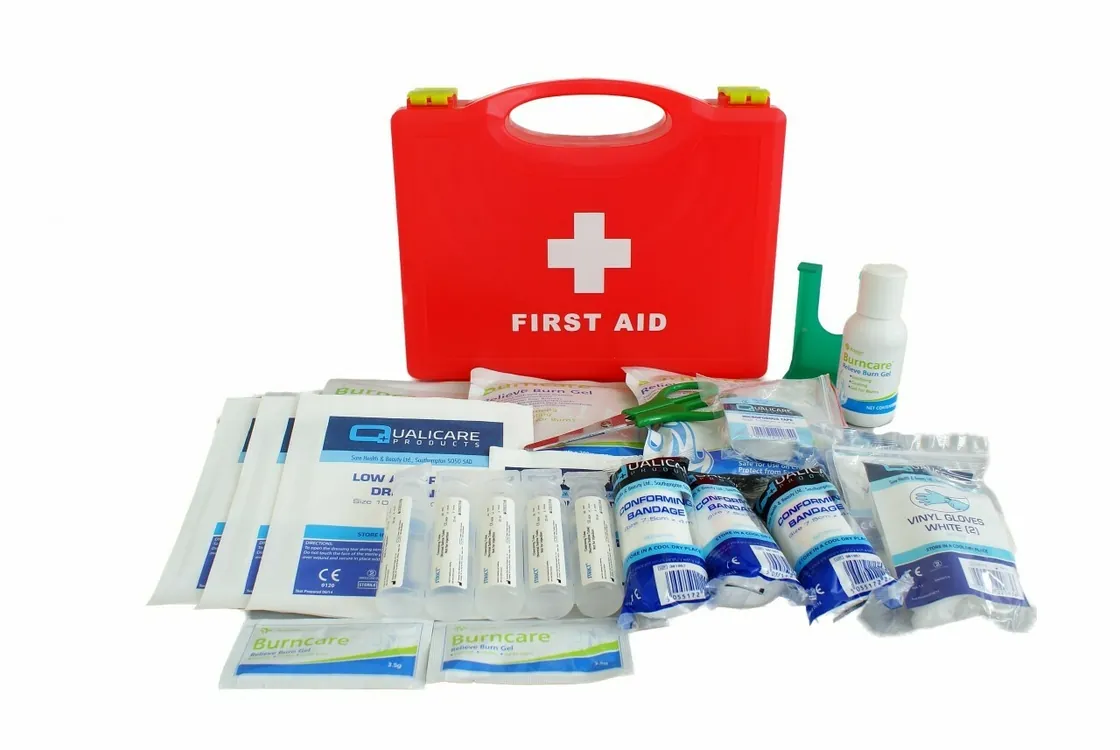
Buying a suitable kit is only part of the job. Employers also need a process for checking, replacing and maintaining first aid supplies.
HSE advises that first aid kits should be checked regularly. Many sterile items have expiry dates and should be replaced when expired. If an item does not have an expiry date, the manufacturer should be checked for how long it can be kept. Non-sterile items should still be checked to confirm they remain fit for purpose.
A regular check, such as a monthly review, can help prevent problems.
Your check should include:
It is also worth reviewing first aid provision after:
For many employers, keeping a spare refill kit on site can make restocking easier after an item is used. This is especially useful in busy kitchens, warehouses, care settings and multi-shift workplaces.
The latest BSI workplace first aid kit standard gives employers a useful benchmark, but it should sit alongside a proper first aid needs assessment.
The main points to remember are:
SHD Medical supplies a practical range of workplace first aid kits, including BSI compliant first aid kits, catering kits and refill options for businesses that need clear, straightforward first aid supplies.
This content provides general information only. It does not replace the full British Standard, product instructions, a competent first aid needs assessment, or official HSE, HSENI or GOV.UK guidance where relevant.
Sources: https://www.hse.gov.uk/firstaid/legislation.htm
https://knowledge.bsigroup.com/products/workplace-first-aid-kits-contents-of-first-aid-kits-and-provision-of-automated-external-defibrillators-aeds-in-the-workplace-specification
https://knowledge.bsigroup.com/articles/standardizing-workplace-first-aid-kits
https://www.firstaidwarehouse.co.uk/blogs/news/what-is-the-latest-bsi-first-aid-kit-standards
https://lp.crestmedical.co.uk/2026-bsi-standards